
Before the Fire Fell, God Dealt With the Messenger
Behind many of the men and women God used powerfully was a hidden battle: the surrender of pride, ambition, comfort, reputation, self-will and the desires of the flesh. Revival does not merely require a message. God prepares the messenger.
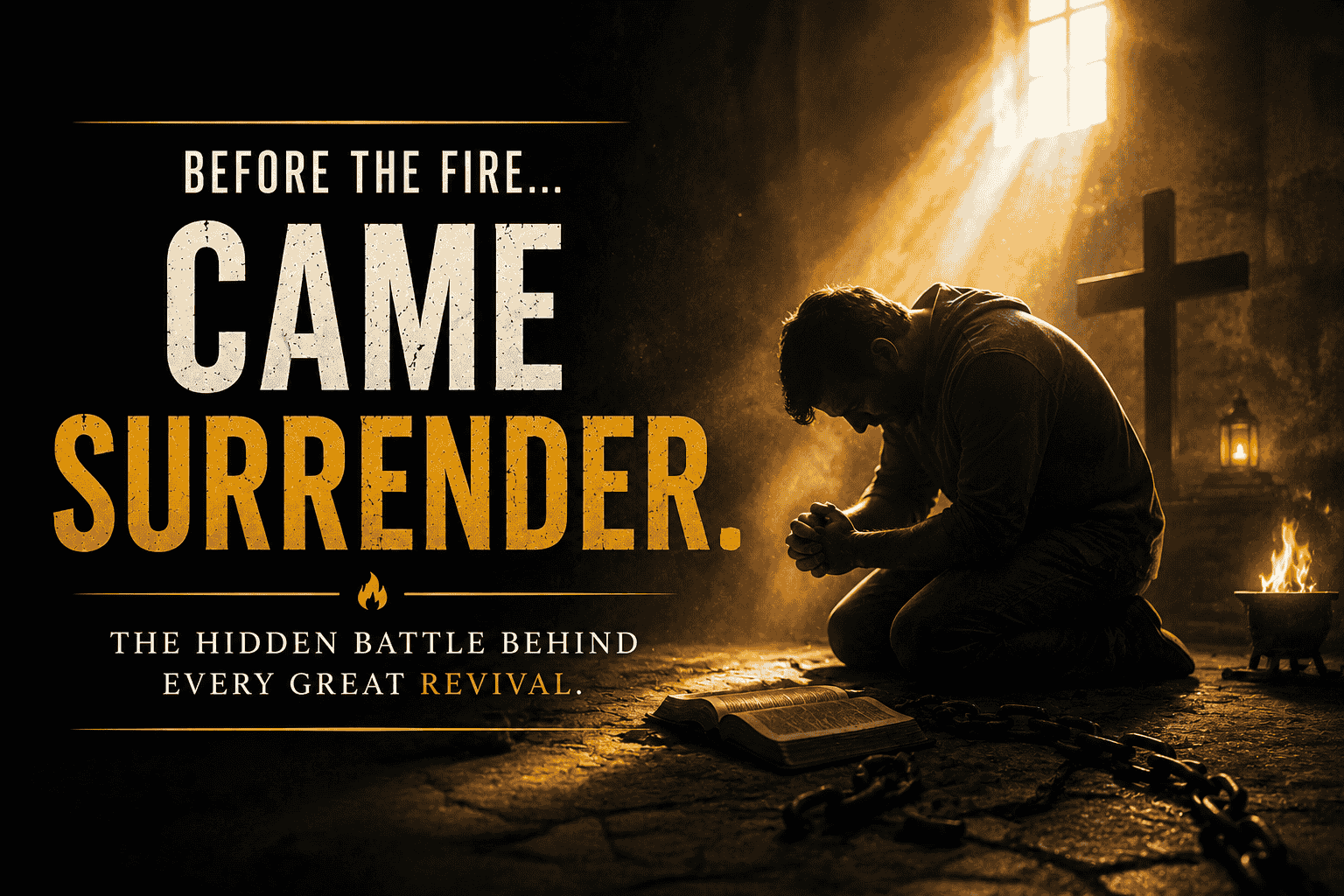
There Is a Side of Revival History We Rarely Celebrate
We remember the crowds.
The conversions.
The extraordinary prayer meetings.
The preaching.
The manifestations of God's power.
But behind many of those stories was another story — a hidden battle taking place inside the messenger.
Before Moses confronted Pharaoh, there was the wilderness.
Before David wore the crown, there were caves.
Before Paul carried the gospel across the Roman world, everything he once considered spiritual achievement had to lose its value compared with knowing Christ.
Again and again, Scripture reveals an uncomfortable principle:
He prepares the messenger.
And one of the greatest battles takes place much closer than we imagine.
It is the battle with the flesh.
The Flesh Can Become Religious
When Christians hear the word flesh, we often immediately think about obvious sins.
Lust. Immorality. Greed. Anger. Addiction.
But the flesh can appear in far more respectable clothing.
It can crave recognition.
It can demand control.
It can become offended when overlooked.
It can compare ministries.
It can secretly enjoy applause.
It can even desire revival because revival might make us significant.
A person can preach about Christ while craving recognition.
A person can pray while wanting others to notice how spiritual they are.
A person can serve God while becoming jealous when somebody else's ministry grows faster.
The danger: The flesh can learn Christian vocabulary. It can stand behind a pulpit, sing worship songs, talk about revival and perform religious activity while self remains on the throne.
The Old Man and the Flesh Are Not the Same Thing
Here we need theological precision.
Christians sometimes pray:
"Lord, help me crucify my old man."
But Paul writes:
— Romans 6:6
Notice what Paul says.
For the believer, the old man is not waiting to be crucified.
Something decisive has already happened through our union with Christ.
Yet the same New Testament tells us:
— Galatians 5:16
Your identity has changed.
But the warfare has not disappeared.
The flesh still attempts to express itself through desires, habits, reactions and patterns that contradict the life of the Spirit.
That distinction matters.
Otherwise, Christians can spend years trying to kill an identity Scripture says has already been crucified while failing to deal practically with the flesh Scripture commands us not to obey.
Why the Wilderness Matters
Perhaps this helps explain why wilderness seasons appear so frequently in Scripture.
Moses had the desert.
David had the caves.
Paul experienced hidden seasons.
Even Jesus entered the wilderness before beginning His public ministry.
The wilderness removes many of the things the flesh uses to measure itself.
No applause.
No platform.
No title.
No visible progress.
Sometimes...
No explanation.
And suddenly deeper questions emerge.
If nobody sees me, will I still pray?
If nobody applauds me, will I still obey?
If somebody else receives the opportunity I wanted, can I rejoice?
If God's timetable contradicts mine, who is really Lord?
Those questions reveal things that public ministry can sometimes hide.
Before Fruitfulness Comes Surrender
Jesus said:
— John 12:24
This is not a command to hate yourself.
Christian surrender is not the destruction of personality.
Nor does holiness mean abandoning every legitimate human desire.
The issue is self-rule.
There comes a point where the believer must stop saying:
My reputation must survive.
My plans must happen.
People must recognize me.
My comfort must be protected.
I must remain in control.
And instead say:
You are Lord.”
Why Revivalists Spoke So Much About Dying to Self
When we read older Christian literature, we repeatedly encounter phrases such as death to self, brokenness, consecration, and crucifying the flesh.
We should understand that language carefully.
These men and women were not teaching that Christ's finished work was insufficient.
They were describing the practical surrender through which the believer stops allowing self-will and fleshly desire to govern the life.
Paul himself wrote:
— Galatians 5:24
The flesh is not negotiated with.
Its demands do not receive the final word.
Its desires do not define our identity.
Its impulses do not determine our obedience.
We walk by the Spirit.
Spiritual Gifts Do Not Automatically Silence the Flesh
This may be one of the most sobering lessons in Christian ministry.
A person can be gifted and still struggle with pride.
A person can preach powerfully and still hunger for applause.
A person can have influence and still be governed by insecurity.
A person can understand Scripture and still resist obedience in private.
Gift is not the same thing as character.
Anointing is not permission to neglect holiness.
Public usefulness does not eliminate the need for private surrender.
A dangerous assumption: “If God is using me, everything inside me must be right.”
Scripture gives us no basis for that assumption.
The Battle Is Not Won by Willpower Alone
There is another mistake believers make.
We discover something wrong within us and decide:
“I will simply try harder.”
Discipline matters.
Boundaries matter.
Obedience matters.
But Christianity is not self-improvement powered by determination.
Paul does not merely say:
Resist the flesh.
He says:
— Galatians 5:16
Victory is not passive.
But neither is it self-powered.
The believer obeys, resists temptation, renews the mind, establishes boundaries and disciplines the body — while depending upon the power of the Holy Spirit.
Revival Begins Closer Than We Think
We often pray:
“Lord, revive the Church.”
“Revive our nation.”
“Send another awakening.”
Those are worthy prayers.
But perhaps revival sometimes begins with a much more uncomfortable prayer:
deal with me.”
Expose my pride.
Expose my ambition.
Expose my hunger for recognition.
Expose the compromises I have learned to tolerate.
Expose whatever competes with Your lordship.
Because God is not merely interested in producing impressive ministries.
He is forming people who increasingly resemble His Son.
Questions We Must Ask Ourselves
- If nobody recognizes me, will I still serve?
- If God says wait, will I still trust Him?
- Do I want God's glory — or the recognition that may accompany ministry?
- What happens inside me when somebody else succeeds?
- What desire becomes strongest when I am tired, angry, lonely or disappointed?
- Is there an area where I repeatedly excuse what Scripture tells me to confront?
- Am I trying to defeat spiritual problems through willpower alone?
- What part of my life still resists the lordship of Christ?
Five Lessons About the Flesh and Revival
1. Your identity in Christ is the starting point.
The believer does not fight to make Calvary true. We fight because
Christ's finished work is already true.
2. The flesh can operate inside religious activity.
Ministry does not automatically remove pride, ambition, jealousy,
insecurity or the desire for recognition.
3. Hidden seasons reveal hidden motives.
The wilderness often exposes what applause and activity allow us to hide.
4. Surrender is not self-hatred.
Biblical surrender means the end of self-rule and the acknowledgement
that Jesus Christ is Lord.
5. Victory requires the Holy Spirit.
Discipline has its place, but lasting holiness is not produced by
willpower alone. We are called to walk by the Spirit.
Frequently Asked Questions
What is the flesh according to the Bible?
In passages dealing with Christian warfare, the flesh describes the fallen patterns, desires and inclinations that oppose the rule of God. It should not simply be equated with the physical human body.
Is the old man still alive?
Romans 6:6 says that the believer's old man was crucified with Christ. The New Testament therefore grounds Christian obedience in what Christ has already accomplished rather than teaching believers to repeatedly crucify their former identity.
Why do Christians still struggle after being born again?
New birth gives the believer a new identity and relationship with God, but Scripture still commands Christians to resist sin, renew their minds, put sinful practices to death and walk by the Holy Spirit.
What does it mean to crucify the flesh?
Galatians 5:24 describes those who belong to Christ as having crucified the flesh with its passions and desires. Practically, this means refusing to allow fleshly desires to rule our decisions and submitting ourselves to the leadership of the Holy Spirit.
Is surrender the same as trying harder?
No. Biblical surrender includes active obedience, but it is fundamentally dependence upon God rather than confidence in human willpower.
Final Reflection: Prepare the Messenger
Perhaps we have spent too much time asking God for bigger platforms.
Greater influence.
Greater opportunities.
Greater power.
But there may be another prayer that should come first.
“Lord, prepare the messenger.”
Deal with what applause might magnify.
Deal with what influence might expose.
Deal with what success might feed.
Teach me to obey when nobody is watching.
Teach me to walk by the Spirit.
Teach me to live from what Christ has already accomplished.
Because perhaps before the fire falls publicly...
God first does His deepest work privately.
Go Deeper: Mastering the Flesh
If you have ever wondered why you can genuinely love God and still struggle with recurring desires, habits and reactions, the battle becomes much clearer when you understand what Scripture means by the old man, the flesh, and walking by the Spirit.
Mastering the Flesh explores these distinctions in depth, including sanctification, surrender, temptation, discipline, deliverance, practical boundaries and Spirit-enabled holiness.
Mastering the Flesh: A Biblical Roadmap to Holiness, Surrender & Revival
Explore Mastering the Flesh →