
The Moravians: The Prayer Meeting That Lasted 100 Years
From a divided community of refugees in eighteenth-century Germany to a century-long tradition of prayer and a worldwide missionary movement.
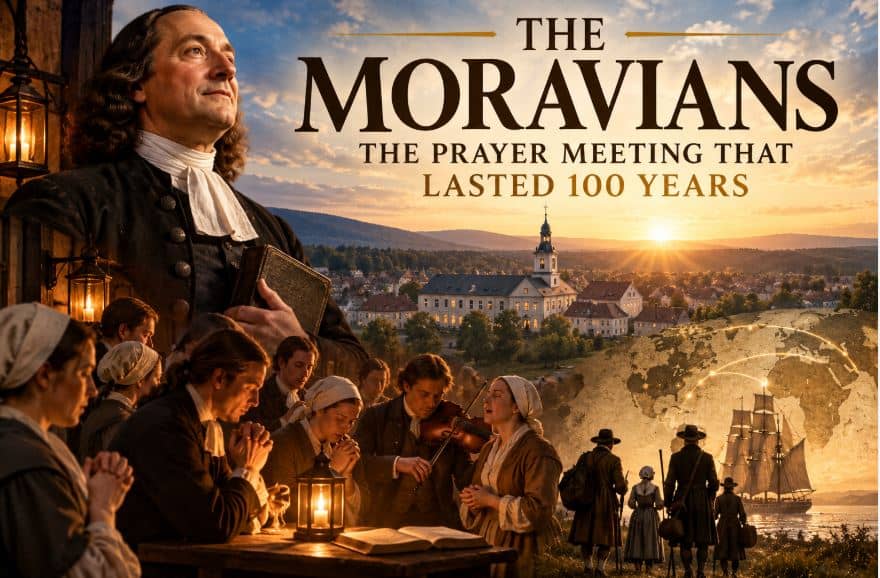
A Prayer Watch That Outlived Its Founders
In the summer of 1727, a small settlement of Christian refugees in Saxony experienced a spiritual renewal that would give rise to one of the best-known prayer movements in Church history. At Herrnhut, believers began a coordinated watch of prayer, taking responsibility for different hours of the day and night. Moravian accounts remember this watch as continuing for approximately a century.
Yet the most remarkable thing about the Moravians was not simply the length of their prayers. Their renewed fellowship produced a missionary movement that reached people far beyond Europe. Their story confronts the Church with a question: can prayer become more than an event on the calendar and instead become the foundation of a community's life?
Before Herrnhut: A Church with Deep Roots
The Moravian Church, also known as the Unitas Fratrum or Unity of the Brethren, traces its beginnings to 1457 in the lands of Bohemia and Moravia, now part of the Czech Republic. Its roots lie in the reforming witness associated with Jan Hus, who was executed in 1415, and in communities that sought a life ordered by Scripture and discipleship.
Over generations the Brethren endured persecution, political upheaval and displacement. By the early eighteenth century, some descendants of this tradition and other Christians were seeking a place where they could practise their faith in peace. The story of the 1727 revival did not begin with a newly invented church; it grew from a long history of costly conviction.
Count Zinzendorf and a Refuge for the Persecuted
Nicolaus Ludwig von Zinzendorf (1700–1760), a young Saxon nobleman shaped by Pietist Christianity, allowed religious refugees to settle on his estate at Berthelsdorf. In 1722, settlers founded Herrnhut, a name often understood as 'under the Lord's watch' or 'the Lord's protection'.
The settlement attracted believers with different religious backgrounds and convictions. Zinzendorf's hospitality gave them shelter, but living together proved more difficult than arriving together. The community faced sharp theological disagreements, suspicion and personal conflict. A common address did not automatically produce a united church.
A Divided Community Learns to Walk Together
By 1727, tensions at Herrnhut threatened its future. Zinzendorf spent time visiting households, teaching, mediating disputes and calling the settlers to practical Christian fellowship. In May, members of the community agreed to a set of principles governing their common life, often called the Brotherly Agreement.
The change was not merely administrative. Believers began to confess faults, seek reconciliation and pray together. The historical record points to a season of preparation, not to an isolated event that suddenly made years of conflict disappear. The movement that followed was rooted in a renewed commitment to Jesus Christ and to one another.
13 August 1727: The Herrnhut Revival
On 13 August 1727, members of the community gathered for Holy Communion at the church in Berthelsdorf. Moravian histories describe the service as a decisive experience of spiritual renewal marked by repentance, reconciliation, deep affection and a powerful sense of God's presence.
The Moravians later remembered the day as a turning point in their corporate life. The central emphasis of the occasion was not a claim that every participant had an identical spiritual experience. It was that a divided people had been drawn together in worship and in renewed devotion to Christ.
The revival did not end when the service concluded. Its fruit appeared in the community's prayer, discipline, relationships and growing concern for people who had not heard the gospel.
— Acts 2:42 (KJV)
The Prayer Watch of August 1727
Later that month, the Herrnhut community organised a structured prayer watch. Participants committed themselves to assigned periods of intercession so that prayer would continue through the hours of the day and night. Accounts often associate its formal beginning with 27 August 1727.
The arrangement was both spiritual and practical. No individual was expected to remain awake and pray without interruption for a hundred years. Rather, members shared responsibility across the community. The watch made prayer a corporate commitment sustained through participation, succession and organisation.
Moravian tradition describes the prayer watch as continuing for approximately one hundred years. The precise continuity of every hour over the entire period cannot be reconstructed from surviving records, so the century-long description is best understood as the movement's historical tradition rather than a claim that every individual shift has been documented.
What Were the Moravians Praying For?
The prayer watch arose from the community's devotion to Christ and its desire to live in fellowship with him. Their concerns included the spiritual health of the congregation, holiness of life, reconciliation, the needs of fellow believers and the spread of the gospel.
Intercession was not a substitute for Scripture, worship, work or practical service. It belonged alongside them. Their approach recalls the pattern of Acts 2:42, where the first believers continued in the apostles' teaching, fellowship, breaking of bread and prayers.
The lesson is not that a certain number of hours forces God to act. It is that persistent prayer forms a people who learn to depend on God, attend to his Word and respond to his calling.
From the Prayer Room to the Mission Field
In 1732, Johann Leonhard Dober and David Nitschmann travelled from the Moravian community to St Thomas in the Caribbean, where they sought to minister among enslaved Africans. Their departure is widely regarded as the beginning of the renewed Moravian Church's overseas missionary movement.
The setting was morally and politically difficult: the Caribbean plantation economy depended on slavery. The missionaries' concern for enslaved people did not, by itself, dismantle that system, and the subsequent history of Moravian missions must be considered with care. Nevertheless, their willingness to travel across the Atlantic reflected the movement's conviction that the gospel was for people whom European society frequently neglected or exploited.
Moravian missions subsequently expanded to Greenland, other parts of the Caribbean, North America, southern Africa and elsewhere. Their work was undertaken by many people, including women and ordinary tradespeople, not solely by famous preachers.
Did Two Moravians Sell Themselves into Slavery?
A frequently repeated sermon illustration claims that two young Moravian missionaries sold themselves into slavery to reach enslaved people on an island and departed crying that the Lamb should receive the reward of his suffering.
The story is moving, but the popular version conflates historical details and is not adequately supported as told. Dober and Nitschmann did travel to St Thomas in 1732 to minister among enslaved people; there is no sound basis for presenting the familiar 'sold themselves into slavery' narrative as an established fact.
The documented missionary sacrifice is significant enough without embellishment. Fire Trail Revival Stories honours these believers best by distinguishing the historical record from later devotional legend.
Historical note: Repeated anecdotes can become detached from their sources. The verified account of the Moravian mission is powerful without adding details that the evidence does not establish.
The Lamb Who Was Slain: The Heart of Moravian Devotion
Moravian spirituality placed extraordinary emphasis on Jesus Christ, particularly his suffering, death and redeeming love. Their worship and hymns repeatedly directed attention to the Lamb of God. The missionary impulse flowed from the conviction that Christ was worthy of worship among every people.
Revelation 5:9 celebrates the Lamb who was slain and who redeemed people to God out of every kindred, tongue, people and nation. That biblical vision helps explain why prayer and missions became inseparable in the Moravian imagination.
Their history is a reminder that a lasting prayer movement requires a greater centre than the movement itself. Its purpose is not to preserve a reputation for prayer but to glorify Christ.
What Sustained the Movement?
The Moravians combined spiritual conviction with communal structure. Their prayer watch distributed responsibility. Their shared worship and pastoral care strengthened fellowship. Their written communications, hymns and missionary reports connected believers across distance.
These practices mattered because enthusiasm alone rarely sustains a commitment over decades. People grow old, leaders die, communities change and fresh generations must decide whether to continue what they have inherited.
There were also weaknesses and disputes in Moravian history. Their experience should not be idealised as a century without human failure. The enduring insight is that spiritual priorities become more durable when a community gives them a practical form.
Five Lessons for the Church Today
1. Reconciliation comes before reputation. Herrnhut's renewal followed a season in which believers confronted their divisions. Public prayer cannot replace the private work of repentance and forgiveness.
2. Prayer can be organised without becoming mechanical. A prayer rota is a tool, not a source of spiritual power. It creates space for people to seek God faithfully.
3. A movement must outlive its founders. The century-long tradition was possible because the responsibility was shared across generations, rather than concentrated in one exceptional individual.
4. Prayer should lead to obedience. The Moravians did not only intercede for the nations; they sent missionaries and accepted the costs of service.
5. Christ must remain the centre. The value of the movement lies not in a record-setting number of hours but in its devotion to the Lord Jesus and its concern that others should know him.
Could a 24-Hour Prayer Watch Work Today?
A church need not begin with a hundred-year promise. It can begin with a modest, sustainable commitment: identify people willing to pray, allocate realistic periods, agree on biblical prayer priorities and establish a way to hand over responsibility when someone is unavailable.
Leadership should encourage participation without treating missed shifts as spiritual failure. A healthy watch includes Scripture, worship, intercession, thanksgiving and room for individual prayer. It also respects the demands of work, family and rest.
The essential question is not how impressive the schedule looks. It is whether the arrangement helps believers grow in prayer, unity, holiness and obedience to Christ.
Frequently Asked Questions
When did the Moravian prayer watch begin?
Moravian accounts commonly date the organised watch to August 1727, often specifying 27 August, after the community's spiritual renewal on 13 August.
Did it really last for 100 years?
The Moravian tradition describes the prayer watch as continuing for approximately a century. Surviving evidence does not independently establish that every hour throughout that period was covered without exception.
Who started the Moravian revival?
Count Zinzendorf was a central leader, but the renewal involved the wider Herrnhut community, including refugee families, ministers and lay believers.
Where was Herrnhut?
Herrnhut is in Saxony, in present-day Germany, near the Czech border.
When did the Moravians begin overseas missions?
The renewed church sent Johann Leonhard Dober and David Nitschmann to St Thomas in 1732.
Were the Moravians the first Protestant missionaries?
No. Protestant missionary efforts predated them. The Moravians were notable for the scale and sustained commitment of their eighteenth-century movement relative to the size of their community.
Final Reflection: A Century Begins with One Hour
The Moravians did not begin with a worldwide organisation or the resources of a wealthy institution. They began as a vulnerable community learning to live together, worship Christ and pray. Their story became influential because devotion was translated into habits, fellowship and action.
We should neither romanticise the past nor dismiss it. The Moravian experience invites us to recover prayer as a shared responsibility, reconciliation as a Christian duty and missions as an expression of love for Christ.
A century of prayer, as remembered in their tradition, began with believers who were willing to take the next hour. The challenge to us is not to admire their watch from a distance, but to become faithful in the opportunities God has placed before us.
Recommended Books & Further Reading
For readers who want to investigate the Moravian revival, its prayer tradition and the wider history of the church, these works offer useful starting points.
- John Greenfield, Power from on High. A short Moravian account of the revival of 1727, its prayer life and missionary consequences. View book on Amazon →
- J. E. Hutton, A History of the Moravian Church. A substantial historical overview of the Unity of the Brethren and the renewed Moravian Church. Find editions on Amazon →
- Arthur J. Lewis, Zinzendorf: The Ecumenical Pioneer. A biography exploring Zinzendorf’s life, convictions and leadership. Find editions on Amazon →
- Craig D. Atwood, Community of the Cross: Moravian Piety in Colonial Bethlehem. A scholarly study of Moravian community and spirituality. Find editions on Amazon →
As an Amazon Associate, I earn from qualifying purchases at no additional cost to you. The first link was supplied by Fire Trail; the other links lead to Amazon search results for the named books so readers can choose an available edition.
Historical Sources
- Moravian Church in America — history and resources
- Moravian Church British Province — history and resources
- J. E. Hutton, A History of the Moravian Church (1909), a historical account that should be read in the context of its period.
- Craig D. Atwood, Community of the Cross (2004), for further study of Moravian piety and community life.